Drop your pressures. Not your standards. Every off-road trip starts with the same ritual: you roll off the bitumen, pull up at the edge of the sand or the head of the track, and let air out of all four tyres so they float over the soft stuff, grip the dirt and soak up the corrugations. What separates a good day out from a slow, frustrating one is how you deflate. Staun automatic tyre deflators and the old manual bleed-and-check routine both get you there, but they get you there very differently. Here is an honest comparison to help you decide what belongs in your kit.
The case for manual deflation
Manual deflation is cheap, and off-roaders have done it forever. You grab a pressure gauge, crouch at each corner, crack the valve and count in your head while air hisses out, then check the gauge, crack it again, check again, and repeat three more times. For a single tyre on a single trip it works fine.
Where it falls down is the maths of a real touring day. Four tyres, several times a day, add up fast. Every stop eats time you would rather spend driving, and the crouching, kneeling and re-checking gets old in the heat. More importantly, manual deflation is only as accurate as your hand and your gauge. It is easy to land at 20psi on one tyre, 18psi on another and 22psi on the third, especially when you are rushing to get moving.
How automatic tyre deflators work
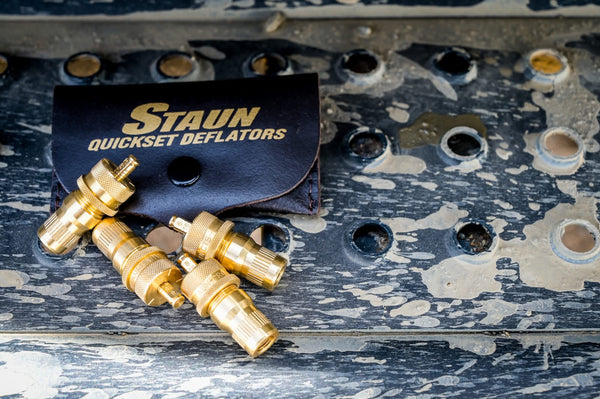
Automatic tyre deflators take the guesswork out of the job. With the Staun Quickset, you set your target pressure on the deflator before you screw it onto the valve, then leave it to do the work. Air flows out until the tyre hits exactly the pressure you dialled in, and the deflator shuts itself off. Screw one onto every valve, and all four tyres are brought down in parallel while you get on with other jobs - dropping your tyre pressure, unpacking, or helping the vehicle behind you.
There is no count, no crouch, no re-check. You set a number and the tool delivers that number, tyre after tyre.
What 1psi accuracy actually means
Spec sheets are easy to write, so focus on what the number does for you on the ground. The Quickset is accurate within 1psi of your setting. In practice that means if you set 18psi, you get 18psi - not somewhere between 17 and 20. All four tyres match, so your 4WD tracks and wears the way it was designed to, and you are not fighting a vehicle that pulls to one side because one corner is running harder than the rest.
That consistency matters most when the pressure is a decision, not a guess. Sand wants a specific footprint. Rock and rough tracks want a specific sidewall flex. Towing wants a specific balance between grip and stability. When your pressures are repeatable, you can actually tune the setup and feel the difference, instead of chasing a moving target every time you stop.
Time, consistency and durability compared
On time, the difference is stark. Manual deflation of a set of tyres is a stop-and-start job measured in repeated rounds of bleeding and checking. The Quickset takes a set of tyres from 35psi to 18psi in 3 to 4 minutes, and it does all four at once. On a trip where you air down two or three times a day, that reclaimed time compounds into a better day out.
On consistency, automatic wins outright. A machine that shuts off at your set pressure does not get tired, rushed or distracted. Manual deflation is exactly as good as the person doing it, on that day, in that heat.
On durability, both approaches live or die by their hardware. The Quickset is Australian made and sold as a set, backed by 350,000+ sets sold and a warranty - gear built for harsh conditions rather than a disposable gadget. A good manual gauge and a bit of hose can last, but they depend on the operator every single time.
Towing and recovery work
If you tow a van, a camper or a boat, or you spend your weekends tugging mates out of soft sand, consistent pressure is not a nicety - it is part of how the whole rig behaves. A tow vehicle and its trailer need balanced pressures to track straight and stay stable, and recovery work rewards tyres that are set exactly where you want them. Guessing your way down to the right pressure before a recovery is the last thing you want to be doing while someone is bogged.
Which should you carry?
If you air down once or twice a year and rarely leave the blacktop, a gauge and patience will see you through. If you are a genuine off-roader - touring, towing, hitting sand, dirt and rough tracks on the regular - the maths tips quickly. Manual deflation trades your time and accuracy for a lower upfront cost. Automatic deflators trade a little upfront cost for speed, repeatable 1psi accuracy and a set of tyres that always match.
That is the real comparison. Manual deflation is a task you do four times over. Staun automatic tyre deflators are a task you set up once and let finish. For drivers who value reliability and precision over a few saved dollars, the answer is straightforward - and the 350,000+ sets already out there suggest plenty of off-roaders have done the same maths.
Set your pressure, screw them on, and get back to the trip. Drop your pressures. Not your standards.