Towing Off-Road: Getting Your Pressures Right for Vehicle and Trailer
Hooking up a camper or caravan changes everything about how your vehicle sits on the ground. More weight over the rear axle, more momentum pushing you into soft ground, and a second set of tyres to think about. Here's how to approach it.
What changes when you tow
- The rear axle carries more weight. That's the axle that will sink first on soft ground, and the one to watch for overheating and sidewall stress.
- The trailer pushes. Downhill and on sand, a loaded trailer is a force you can't ignore, and once it's bogged behind you it's a long recovery.
- The trailer has its own tyres. They're usually smaller, run at their own pressures, and do their own share of the digging.
The principle
Start from your vehicle's placard, then adjust for the load. A loaded tow vehicle generally wants a little more air in the rears than the same vehicle unloaded, so it can carry the weight without wallowing.
From there, apply the normal off-road logic: drop for sand, corrugations and rock, but remember the rear tyres are working harder, so don't take them as low as you would solo. You want enough pressure to carry the load and enough flex to keep grip.
For trailer tyres, drop proportionally. They carry less weight than the tow vehicle, so they generally want less pressure, but check the tyre's own rating and the trailer manufacturer's guidance before you go low.
Sand with a trailer
This is the hard one. Air down more than you would solo, and keep momentum. A trailer that stops in soft sand is much harder to get moving again than a vehicle on its own. If you're crossing a long beach, plan for a run-up and keep your speed steady rather than accelerating and braking.
Corrugations and rough dirt
Dropping pressure smooths the ride for the tow vehicle, but watch the trailer. Softer trailer tyres can start bouncing and swaying as speed climbs, so find a pressure and a speed where it tracks calmly behind you.
Airing up before the highway
Reinflate both vehicle and trailer before you settle into a long highway run. Soft tyres at speed build heat quickly, and a loaded vehicle on hot, low tyres is the worst place to be.
Set it once
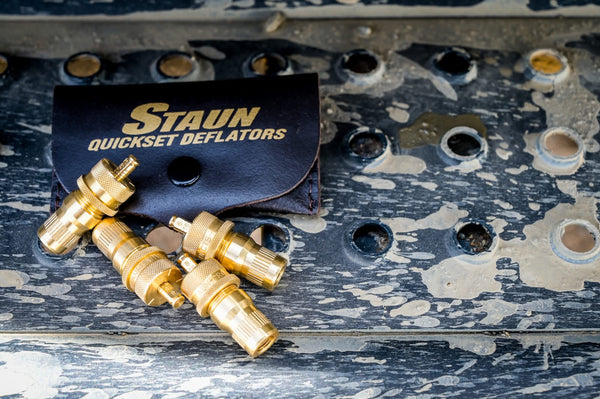
With Stauns, your usual tow pressures stay where you set them. Screw them on, do all four tyres together, and they stop at your chosen number, accurate to within 1psi.
For a starting range, see our recommend pressure guide.