Recommended Tyre Pressures by Terrain: Sand, Gravel, Rock and Snow
The right pressure depends on your vehicle, how it's loaded, the tyres you run and the ground under them. There's no single number that suits every setup, but there are well-established starting points you can adjust from.
Check these before you drop anything
- Your vehicle's tyre placard and owner's manual come first.
- A heavier vehicle or a heavy load needs more air, not less.
- Taller tyres with more sidewall generally tolerate lower pressures than low-profile rubber.
- Speed is the real enemy of low pressures. Heat builds fast above about 60km/h, so low pressures and highway speeds don't mix.
- Never go below the minimum your tyre and rim manufacturer specifies for the speed you're driving.
Common starting points
These are typical off-road starting ranges, not hard rules. Use them as a baseline and adjust for your setup.
- Soft, dry sand: around 16 to 20psi
- Firm or damp sand: around 20 to 24psi
- Gravel and corrugated dirt: around 22 to 26psi
- Rocky tracks and technical terrain: around 20 to 24psi
- Snow: around 18 to 22psi
- Highway: back to your placard pressure before you settle into a long drive
How to test and adjust
Start at the higher end of the range. Drive a short stretch, then check how the vehicle is behaving: whether it's floating or digging, whether the ride has smoothed out, and whether the tyre is flexing the way you want. If the vehicle is still labouring, come down a little more. If it feels vague or wallowy, add a couple of psi.
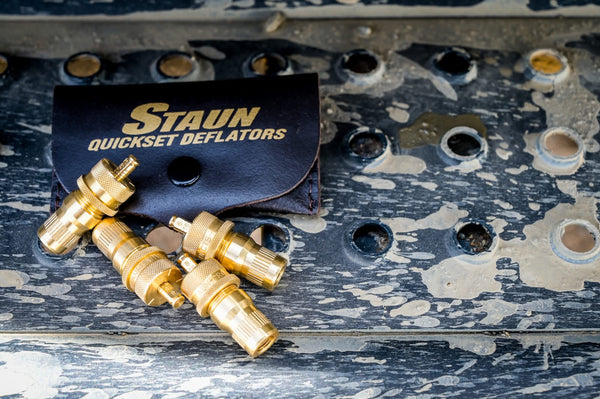
Set it once with Stauns
Because Stauns hold their setting, you can dial in your go-to pressure for your usual terrain and stop thinking about it. Set your target once, screw them on, and every tyre stops at the same number, accurate to within 1psi.
Don't forget to air up
Soft tyres at highway speed build heat, wear quickly and handle poorly. Reinflate at the servo or with your onboard air before the long drive home.
For setup instructions, see our First-Time Setup guide.